

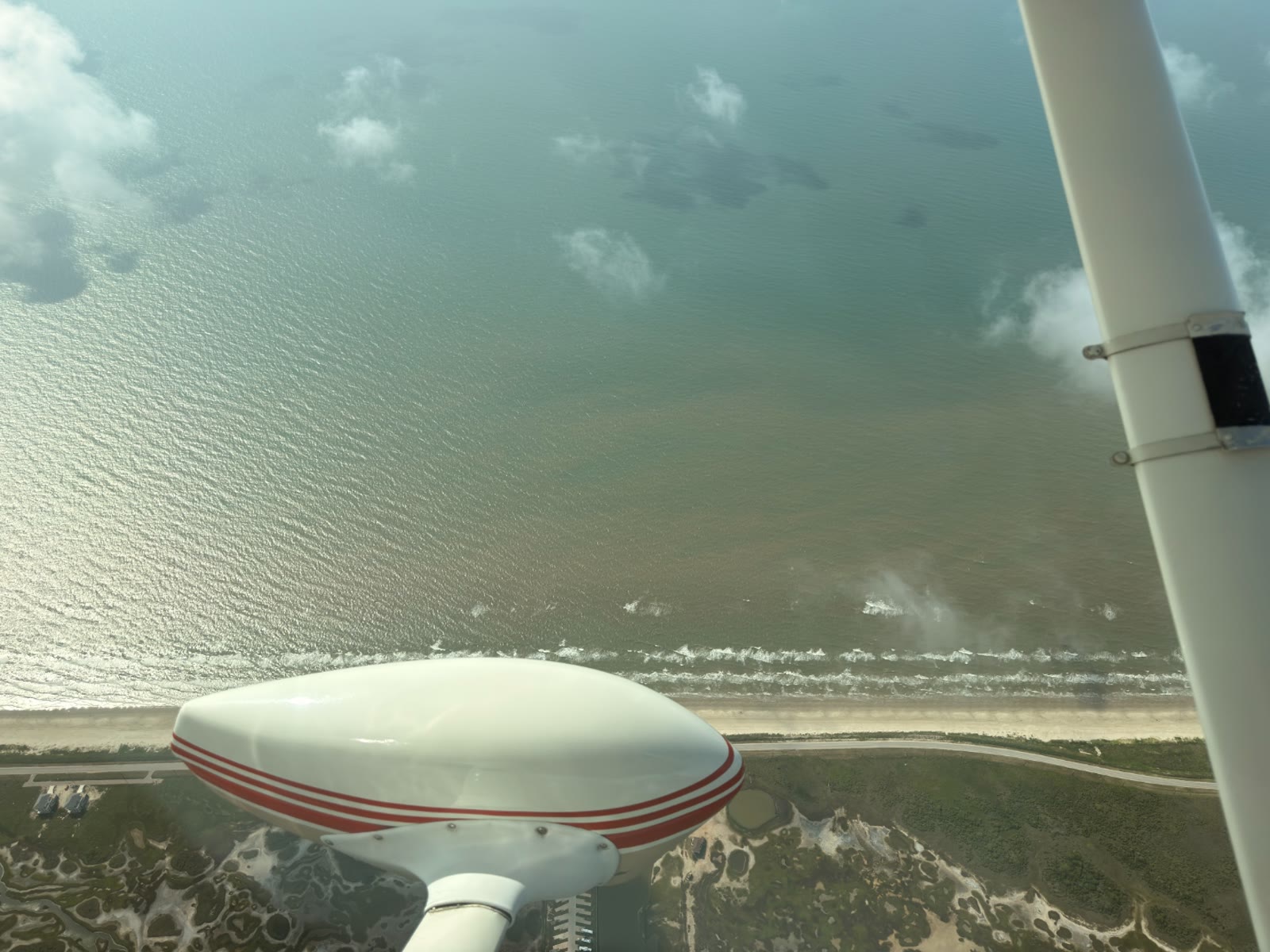
On a family trip to the Houston and Pearland area, I flew a 49-year-old, dry-rented Cessna 172 at Pearland Regional Airport (KLVJ), and my last job after the 1.7-hour lesson was using the airport's self-service fuel pump for the first time. It was a useful local flight that became a lesson full of firsts.
My normal reference point is Centennial Airport (KAPA) in Colorado, a high-elevation, towered environment where density altitude, mountain-adjacent weather, busy radio work, and familiar avionics shape the routine. KLVJ was nontowered, nearly at sea level, hot and humid, and flown in an older airplane with a traditional six-pack panel. None of that made the lesson exotic. It made it honest. Change the airplane, airport, terrain, or weather, and habits that felt automatic suddenly need to be deliberate again.
KLVJ Was a Different Kind of Training Environment
Pearland Regional is a nontowered airport with a published field elevation of 44 feet MSL. Its single concrete runway is 14/32 and measures 4,313 by 75 feet, details worth knowing before arriving because runway orientation and available pavement shape every pattern plan (Pearland Regional Airfield Information). The airport itself is not complicated, but it asks for a different rhythm than a towered field.
At KAPA, the radio and the tower impose useful structure. There are instructions to copy, runway assignments to confirm, and a controller helping sequence traffic. At a nontowered field, the pilot still has structure, but supplies more of it personally: listening before transmitting, building a picture of traffic, choosing a safe pattern entry, and making position reports that help other pilots understand the plan. The radio is not quieter work. It is self-managed work.
That is why an unfamiliar airport is such a good training tool. It removes the comfort of knowing exactly where each taxiway, reporting point, or local landmark will appear. The right response is to review the airport information, think through the pattern, and remember that unfamiliar does not mean unsafe. It means slow down enough to make a plan.
Sea-Level Performance Is Not Just a Chart Concept
The first big contrast showed up on takeoff. Even with temperatures in the 90s, the Cessna's takeoff and climb performance felt noticeably stronger than the high-density-altitude operations I am used to around KAPA. I am intentionally not attaching a takeoff roll, rate of climb, weight, or density-altitude number to that observation. The lesson was qualitative, but it was obvious.
Density altitude is the way pilots translate nonstandard temperature, pressure, and humidity conditions into a performance picture. Higher density altitude means the airplane behaves as if it were operating at a higher altitude, with less engine, propeller, and wing performance available. The FAA covers the underlying performance and engine-system concepts in the Pilot's Handbook of Aeronautical Knowledge. On this flight, the hot weather still mattered, but the low field elevation was impossible to miss.
The practical takeaway is not that sea-level airports make performance planning optional. They do not. It is that performance is a local problem, not a place-name problem. A pilot accustomed to Colorado can become conditioned to weak climb and long-feeling acceleration, while a pilot who usually flies near sea level can be surprised by the opposite transition. Use the airplane's POH, the actual conditions, and a real preflight performance calculation every time. Then let the flight teach you what the numbers feel like.
Warm, Humid, and Still VFR
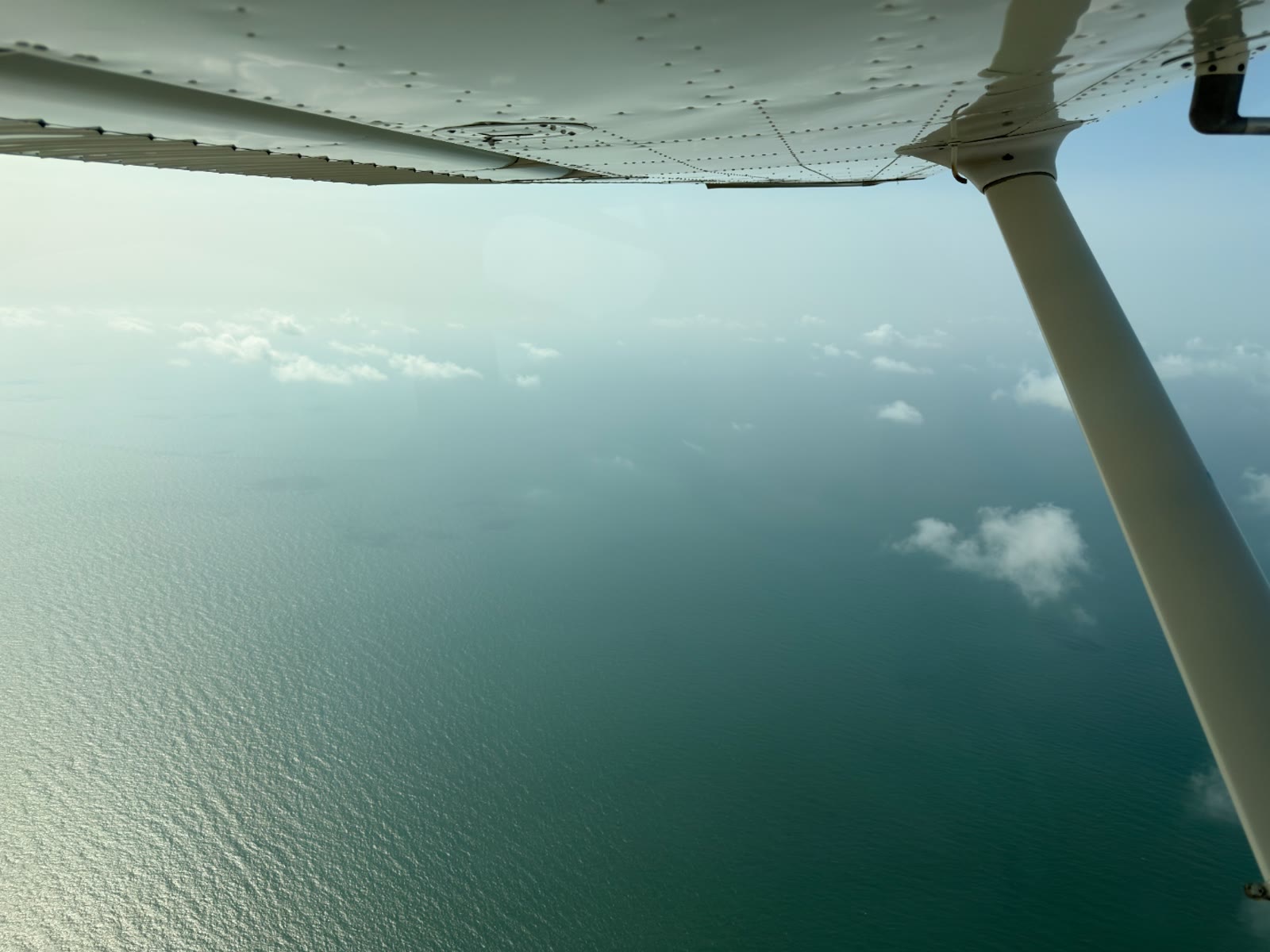
The weather was another reset. Temperatures were in the 90s with high humidity and scattered, layered clouds with bases roughly around 4,000 feet MSL. The air was mostly smooth. That was a welcome contrast from the kind of Front Range flying where terrain, heating, wind, and local conditions can produce a much bumpier ride. It was one day, not a rule: the Gulf Coast is not always smooth, and Colorado is not always rough.
The useful lesson was to keep treating cloud clearance as a planning problem, not an aesthetic one. Under VFR, a cloud layer can turn a comfortable altitude into a trap if it narrows the room needed to remain clear of clouds, terrain, airspace, and traffic. A nice view below a scattered layer is only useful if the pilot can maintain legal cloud clearance, keep visual reference to the surface, and preserve an out if the gaps begin to close.
That is especially easy to forget in a new area. The outside picture looked different from the visual environment I know around home, and the lower cloud bases made altitude selection more intentional. The answer was not to invent a magic altitude. It was to keep looking ahead, maintain VFR margins, and stay willing to change the plan. The FAA's Airplane Flying Handbook is a good reminder that maneuvering and traffic-pattern work begin with situational awareness, not just control inputs.
Carb Heat Was Back on the Workload List
This Cessna 172 was carbureted, so carburetor heat was part of the normal workload. That is a small change in equipment, but it is a meaningful one when most of your mental routines have been built around a different airplane. Carburetor icing can occur in warm, humid conditions because the pressure drop and fuel vaporization in the carburetor can cool the incoming air enough for ice to form. The FAA discusses this mechanism and its operational risks in AC 20-113, Pilot Precautions and Procedures To Be Taken in Preventing Aircraft Reciprocating Engine Induction System and Fuel System Icing Problems.
That does not mean humidity alone calls for leaving carb heat on continuously. Carb heat is used in accordance with the specific aircraft's POH and checklist when the conditions and power settings warrant it. In a fixed-pitch propeller airplane, an unexplained RPM drop and engine roughness can be signs that deserve attention. The right response is not a generic internet rule. It is to know the airplane's approved procedure before takeoff and apply it when appropriate.
For students, the larger point is simple: equipment differences create workload differences. Before flying an unfamiliar trainer, ask what is not the same. Carb heat, fuel-system configuration, flap operation, electrical equipment, engine indications, and emergency checklists are all worth a focused preflight review. Familiar category does not mean familiar machine.
My First Lesson Behind a Traditional Six-Pack
This was also my first lesson in a traditional six-pack airplane. The basic flight instruments were there, but their physical arrangement was different from what I was used to. Some of the gauges were harder to read, and identifying them took a little more deliberate attention. After a few minutes, I adapted and did well, but the adjustment was real.
The six-pack is the classic arrangement of the airspeed indicator, attitude indicator, altimeter, turn coordinator, heading indicator, and vertical speed indicator. Students do not need to turn that list into trivia. They do need a scan that checks the airplane's attitude, performance, and direction without staring at one instrument. The PHAK explains why instrument interpretation is a cross-checking task rather than a single-gauge task.
There is also a healthy humility in flying a simpler panel. Familiar avionics can make a scan feel automatic, but that familiarity does not transfer perfectly when instrument faces, markings, or supporting gauges change. The lesson was not that older panels are better. It was that the pilot's basic scan and situational awareness should survive an avionics change.
Maneuvers Look Different Somewhere New
We worked on S-turns and steep turns, familiar maneuvers in an unfamiliar visual setting. The control fundamentals did not change: fly coordinated, manage bank and pitch, divide attention between the outside picture and the instrument scan, and correct early rather than chasing errors. What changed was the visual reference library.
Ground reference maneuvers are a good example. A coastline, road, body of water, or other prominent feature can be a useful general visual cue, but no landmark removes the need to evaluate wind. The goal of S-turns is not to trace a pretty shape on the ground. It is to recognize drift and vary the correction as the airplane's direction relative to the wind changes. The FAA's Airplane Flying Handbook covers the wind-correction logic behind ground reference maneuvers and the performance-management habits that make steep turns useful training.
The lesson for me was that a maneuver can be technically familiar while the setup is not. Different terrain and different references force you to explain what you are seeing instead of relying on recognition alone. That is good practice. A private pilot will not always get the same practice area, same sight picture, or same wind direction.
The Nontowered Pattern Requires a Plan Before the Pattern
The arrival was the part that felt most different from my usual towered routine. The procedure was an overflight followed by a teardrop-style maneuver to join the midfield downwind. We overflew the airport above pattern altitude, continued clear of the pattern, descended, then turned back to enter the downwind at 45 degrees near midfield.
That sequence is useful because it separates the jobs. First, get a good look at the airport and pattern environment. Then remain clear while descending rather than cutting through active pattern traffic. Finally, make the standard 45-degree entry to the downwind near midfield. The exact choice of entry should always fit the airport, published information, wind, traffic, and safety picture. The core idea is predictable integration, not drawing a clever shape in the sky.
It was a fairly busy day at KLVJ, and my instructor and I spent a meaningful amount of the lesson visually searching for traffic. That was useful work, not dead time. At a nontowered airport, CTAF monitoring and clear self-announcements help build a picture, but neither replaces looking outside. The FAA's AC 90-66B, Non-Towered Airport Flight Operations explains the role of CTAF, recommended traffic-pattern practices, and the need for pilots to remain alert for aircraft that may not be on the frequency. Not every aircraft may be transmitting, and hearing no calls is not proof there is no traffic.
Last Job: Fuel the Airplane
The Cessna was rented dry, so after shutdown I used the airport's self-service fuel pump. It was my first time self-fueling an airplane, another small but real first folded into the day. It was not the main event, but it was a useful reminder that flying includes ground responsibilities after the flight as well as before it.
Self-fueling adds real responsibility because the pilot must follow the aircraft, airport, and pump procedures and verify the correct fuel before it goes into the airplane. I will leave the exact process to the airplane's documentation and the local procedure, but the training takeaway is broader: unfamiliar ground operations deserve the same deliberate attention as unfamiliar airspace or a new panel.
Seven Takeaways for an Unfamiliar Airplane or Airport
- Brief the differences before the engine starts. Field elevation, runway layout, pattern direction, radio plan, fuel system, carb heat, flap operation, panel layout, and unfamiliar ground operations deserve more than a quick glance.
- Treat self-service fuel as a pilot task, not a formality. When an airplane is rented dry, follow the applicable aircraft, airport, and pump procedures and verify the correct fuel before it goes into the airplane.
- Calculate performance, then stay curious about it. The POH is the authority. The takeoff and climb will still teach you how that performance feels at a new airport and on a new day.
- Keep VFR margins visible. New scenery and attractive cloud layers can distract from the basic job: stay clear of clouds, maintain visual reference, and keep a conservative exit plan.
- Use tools without outsourcing awareness. A moving map, a familiar checklist flow, or a tower can reduce workload, but none should replace outside scanning, position awareness, or active decision-making.
- Budget attention for traffic at a busy nontowered airport. CTAF helps build the traffic picture, but visual scanning needs real time and attention because not every aircraft may be transmitting or calling.
- Make your arrival predictable. Monitor CTAF, build a traffic picture, remain clear when needed, and enter the pattern in a way other pilots can anticipate. There is no prize for the most creative pattern entry.
Bottom Line
This 1.7-hour lesson at KLVJ was not about collecting a new airport code. It was a collection of useful firsts: my first KLVJ flight, first time self-fueling, first lesson behind a traditional six-pack, a busy nontowered arrival at KLVJ, and a sea-level lesson in a 49-year-old Cessna 172. It was also a compact exercise in adaptation, from hot and humid VFR weather and carb heat to visual maneuvers in unfamiliar scenery and a busy arrival that needed a clear plan.
The 49-year-old Cessna 172 did exactly what a good trainer should do. It made the fundamentals visible. Fly the airplane, know the systems, use the weather and performance information, look outside, and make predictable choices around other traffic. I was happy to have experienced all of it, because the more different the environment is from home, the more those basics matter.